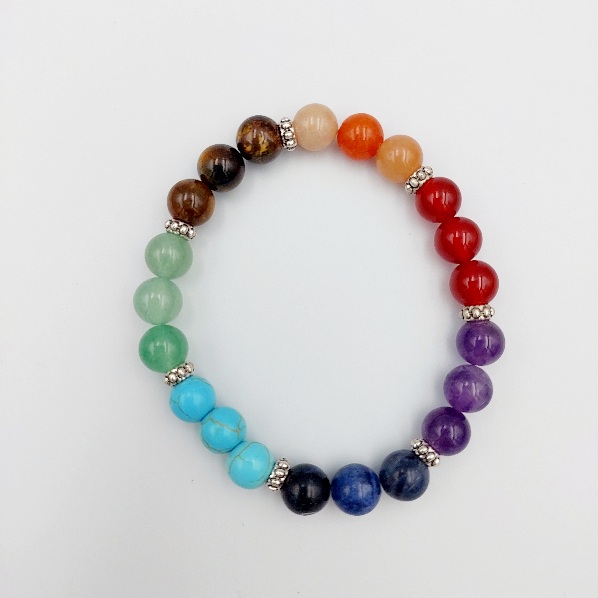
7 Chakra bracelet 3beads
R89,00
Stretch bracelet with 8mm beads. The turquoisy, red and dark blue beads are natural but dyed Howlite, and these beads may show a bit of colour wear on the inside where they touch each other.
The other beads are amethyst, aventurine and tigers eye.
We can’t make a bracelet to the exact cm for every customer, since the size of the bead, and how it lies, may throw that off. However, we aim to get it as close to your sizing as possible. They are also stretchy. So, we will appreciate it if you could select the sizing for the bracelets from the following list (if it is different sizes please indicate for every bracelet).
1) Woman small 2) Woman Medium 3) Woman Large 4) Man small 5) Man medium 6) Man Large
Please indicate your choice under Order Notes when you check out.
Availability: 2 in stock
The seven chakras
Chakras are the circular vortexes of energy that are placed in seven different points on the spinal column, and all the seven chakras are connected to the various organs and glands within the body. These chakras are responsible for disturbing the life energy, which is also known as Qi or Prana
There is growing evidence from the research of meditation that indicates that the Central Nervous System (CNS) maps directly over the chakra system, and that there exists some link to mind-body integration. More recently, scientists have discovered the significance of the vagus nerve on wellbeing. This nerve, known as “The Wanderer,” connects brain and body. And, guess what? It is stimulated by deep breathing, which then calms down the body’s CNS.
For the purpose of growth, the seven main chakras can be used as a tool and a roadmap, helping millions of people across thousands of years in their quest for self-development.
The origin of the chakras and subtle body
The word chakra comes from the Sanskrit C̣akra, meaning “wheel” or “disc,” and the early concept of the chakras originates from Indian philosophy. They’re said to be spinning discs of psychic energy belonging to the “subtle body” (sukshma sarira).
e Self:
- The root chakra links to physiological needs
- The sacral chakra links to safety needs
- The solar plexus chakra links to belonging needs
- The heart chakra links to self-esteem
- The throat chakra links to self-actualization
- The third eye chakra and crown chakra link to self-transcendence
One way of looking at the chakra system is a point of reference to understand what area of life needs to be explored. There are said to be associated physical or emotional symptoms when specific chakras aren’t in harmony, which gives insight into what the unconscious is attempting to teach.
| Weight | 0,022 kg |
|---|---|
| Dimensions | 3 × 3 × 3 cm |
Reviews
There are no reviews yet.